Explore the HoloDock
from the inside.
HoloDock turns a phone into a spatial computer. Every layer inside it exists to put a holographic image in the room, track what is around it, and let an agent act on what it sees. Scroll to take the device apart, layer by layer.
Skip to the interactive explorer- 10
- Addressable layers
- 12
- Precision components
- 52 × 14 mm
- Machined body
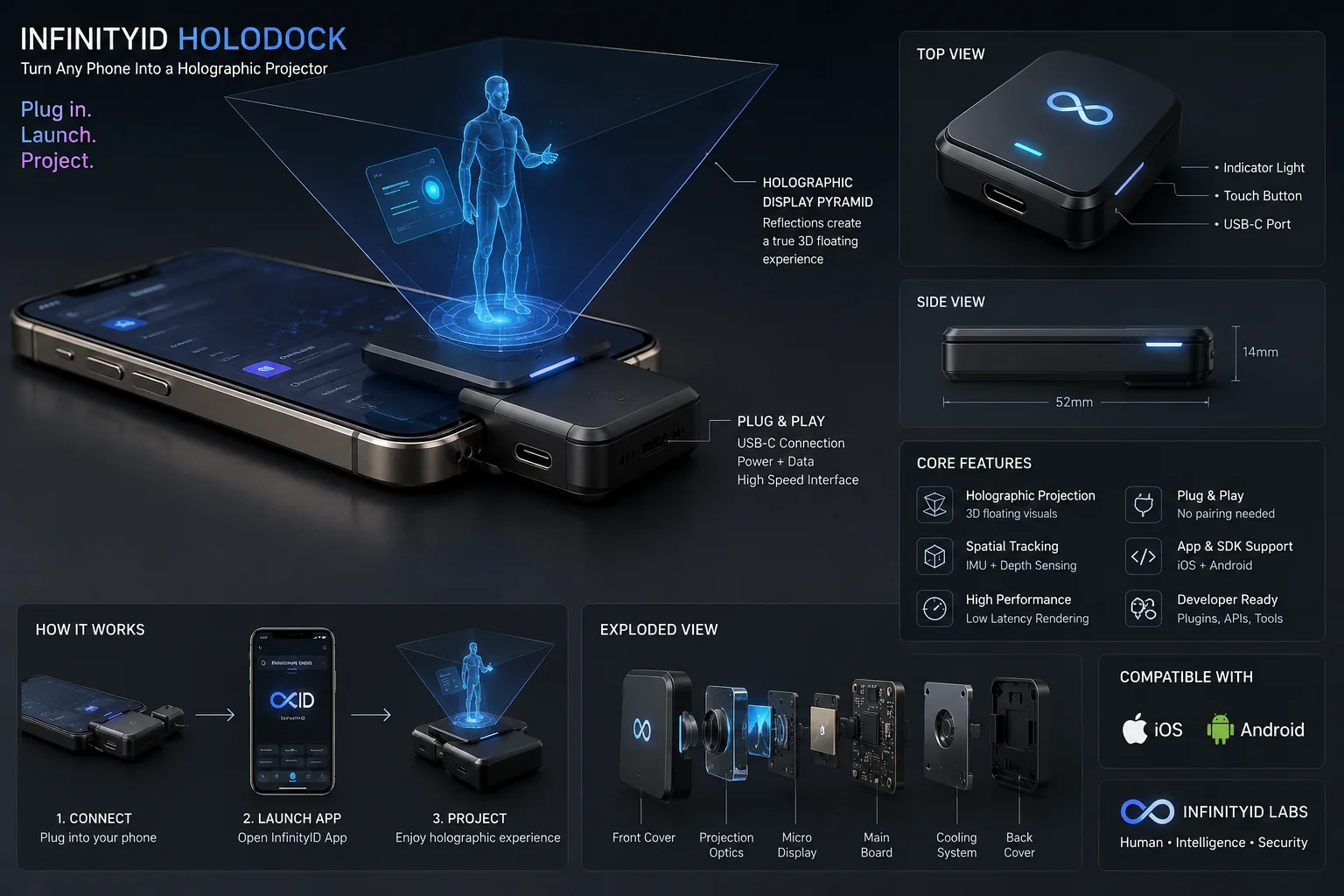
Assembled
One object, ten layers.
52 × 14 mm of machined aluminium with an optical engine, a sensor package and an NPU inside. Keep scrolling and it comes apart along its assembly axis, one layer at a time.
HoloDock / device architecture
Take it
apart yourself.
Drag to rotate, scroll to zoom, and open any of the ten layers. Selecting a layer moves the camera to it and dims everything else.
- Addressable layers
- 10
- Precision components
- 12
- Body
- 52 × 14 mm
- Interface
- USB-C
Drag to rotate · scroll to zoom
After assembly
The hardware is half of it.
Ten layers put light in the room. What decides what that light shows is the software stack on the phone — and the tools you connect to it.
SpatialOS
The operating layer that claims the dock, composes the scene and renders every frame it projects.
Open sectionMCP Gateway
Your own servers, exposed as tools the Agent Kernel can call — scoped, audited and revocable.
Open sectionOpenware
A declared plugin model that gives an app you already ship a spatial surface on any paired dock.
Open sectionBuild for HoloDock.
Connect your apps, agents and tools to InfinityID SpatialOS and start building interfaces that move beyond the screen.
SDK access can begin before HoloDock hardware is available, using the SpatialOS simulator.